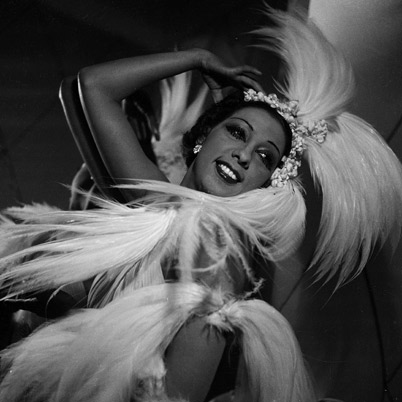
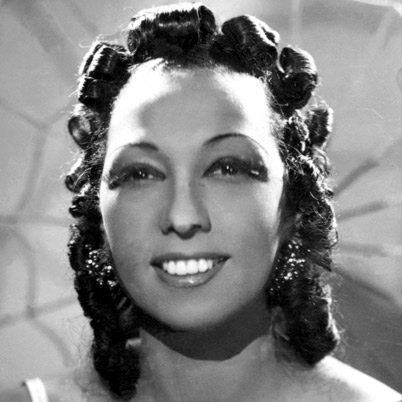
Josephine Baker is one of the most extraordinary people to ever grace the face of the earth.
Josephine Baker was born Freda Josephine McDonald on June 3, 1906 in St. Louis, Missouri. Living in the slums of St. Louis. Starting from the age of eight Josephine was put to work cleaning houses. Josephine's street corner dancing attracted attention and at age 15 she was recruited for the St. Louis Chorus Vaudeville Show. During the Harlem Renaissance, Josephine found her way to New York City where she performed in various venues.
In 1925 Josephine Baker traveled to Paris, France and on October 2nd she opened La Revue Nègre at the Théâtre des Champs-Élysées. The show and Josephine were an instant success.
In American society at that time Josephine was not considered anything special, however, in France she was seen as an exotic beauty. The French people loved and appreciated her dark beauty. Josephine was given the nicknames "Bronze Venus", "Black Pearl" and "Creole Goddess". She became the toast of Parisian society.
Josephine Baker's style of dance was very erotic. Miss Baker was also very comfortable with her body image which was evident at every performance. Josephine appeared nearly nude on stage.
After touring Europe with the show, Josephine Baker reneged on her contract and returned to France because in America she was looked down upon as a woman of color. In France Josephine was more comfortable being herself. She was not made to feel like a second class citizen, but instead equal to the French people. Josephine went to on star at the Folies Bergères on a regular basis.
Josephine developed her own personal style that was truly elegant.
This is one of my favorite photographs of Josephine Baker.
There are probably thousands of photos of Josephine Baker and it is a shame that most of them are in black and white. Josephine had a very interesting looking face that was impeccably fashioned with makeup. I would have loved to see what Josephine looked like in color in her evening finery and stage costumes.
Josephine Baker appeared in four films that only experienced success in Europe. They are La Sirène des tropiques (1927), Zouzou (1934), Princesse Tam Tam (1935) and Fausse Alerte (1940).
Josephine Baker in the film La Sirène des tropiques
Josephine Baker in the film Princess Tam Tam.
Josephine Baker in the film Zouzou.
Miss Baker showed her love and appreciation for France, the country that welcomed her with wide opened arms. During WWII, Josephine offered herself up to work for the French government as a spy.
Jo Bouillon and Josephine Baker
Josephine Baker was married four times. Her husbands were:
- Willie Wells (1919)
- Willie Baker (1921)
- Jean Lyon (1937)
- Jo Bouillon (1947)
Jo Bouillon and Josephine Baker
Josephine arriving in St. Louis with her husband Jean Lyon.
Josephine adopted twelve children which she called her rainbow tribe. Her forth husband Jo Bouillon helped her to raise the children.
Besides Josephine 's work for the French government she also became active in the American civil rights movement, even though she was based in France. Whenever Josephine performed in America she refused to perform to segregated audiences.
Josephine Baker worked with the NAACP and was a key speak at the March On Washington alongside Martin Luther King Jr.
The historic March on Washington took place on August 28, 1963.
Martin Luther King Jr. at the March on Washington.
Josephine Baker at the March on Washington.
More stylish and memorable photos of Josephine Baker
The above photo is another one of my favorites of Josephine. There is a certain elegance to this partially nude photo.
Frida Kahlo and Josephone Baker
Josephine Baker left us on April 12, 1975 at the age of 68, and the world has not seen another like her since.